Direct-to-Consumer Prescription Access Increases the Need for Content Checking
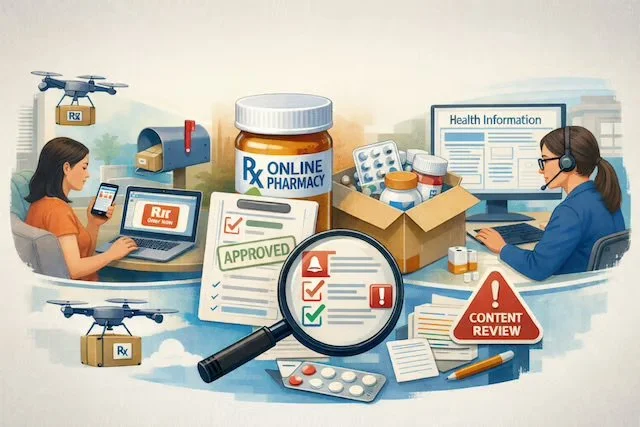
Healthcare delivery is undergoing a structural shift as direct-to-consumer (DTC) access to medications expands rapidly. Patients are no longer relying exclusively on traditional in-office prescribing and pharmacy dispensing models. Instead, they are increasingly purchasing prescription and over-the-counter products through retail and online channels that offer home delivery, digital prescription management, and real-time price transparency.
The Retail Healthcare Transformation
Major retailers such as Walmart, CVS, and Amazon Pharmacy have accelerated this transformation by making medication access faster, more convenient, and often more affordable. For consumers, the appeal is clear: greater control over health decisions, fewer logistical barriers, and the ability to manage treatment from anywhere. For the healthcare ecosystem, however, this evolution introduces a new layer of regulatory and compliance complexity.
Expanding Content Channels
As medications move closer to the consumer purchase environment, the volume of consumer-facing educational and promotional content is expanding dramatically. Product webpages, retail displays, digital ads, patient education hubs, mobile apps, and third-party informational platforms all represent communication channels where regulated claims may appear. Each of these touchpoints must meet the same strict standards for accuracy, substantiation, and fair balance that historically governed physician-office materials and traditional advertising.
Regulatory Expectations Remain Consistent
Regulators—including the FDA, FTC, and state authorities—make no distinction between distribution channels when evaluating promotional compliance. Whether a consumer encounters information in a clinic, on a retailer's website, or through a digital pharmacy platform, the expectations remain identical: communications must be truthful, balanced, and not misleading. If claims about product benefits, risks, or intended use fail to meet these standards, enforcement actions such as warning letters, corrective messaging, or financial penalties may follow.
Increasing Operational Risk
This convergence of retail healthcare, digital commerce, and consumer-directed communication significantly increases the operational risk associated with content creation. Pharmaceutical manufacturers, retailers, distributors, and marketing partners must now manage far larger volumes of content moving at faster speeds across more channels than ever before. As a result, systematic and scalable content-checking capabilities—combining regulatory review processes, rules-based verification, and AI-enabled monitoring—are becoming essential infrastructure rather than optional safeguards.
Looking Ahead
The continued growth of DTC prescription access is likely to reshape how healthcare information is produced, distributed, and governed. Organizations that invest early in robust content-checking frameworks will be better positioned to support consumer access while maintaining compliance, protecting public health, and reducing regulatory exposure in an increasingly consumer-driven medication marketplace.
About SecureCHEK AI
SecureCHEK AI is a Software-as-a-Service (SaaS) system that seamlessly integrates with enterprise platforms to enhance MLR efficiency. Purpose-built for pharmaceutical and medical device companies, the software helps MLR reviewers efficiently assess and mitigate compliance risks and reduce comments and re-reviews.
SecureCHEK AI leverages a full hybrid AI model—the gold standard architecture for accuracy and hallucination control to ensure confidence and trust in the findings. Rapid deployment and the user-friendly interface minimize the learning curve, making it easy to get started.
Contact us for a demo to learn how SecureCHEK AI builds libraries and executes prechecking.